Your Cart is Empty




Quick Summary
The main difference between emery cloth and sandpaper is that emery cloth uses a tough woven cloth backing with hard, coarse emery grit that holds up under pressure on metal, making it ideal for rust removal, deburring, polishing, and cleaning oxidation on pipes, shafts, and sharp edges. Sandpaper, on the other hand, offers a much wider grit range and more abrasive options, which makes it the better all-around choice for woodworking, drywall, paint prep, plastics, and fine finishing (including ultra-fine grits for polishing and wet sanding).
When you want to remove material or smooth surfaces, you need a quality abrasive. Both emery cloth and sandpaper can do the job and do it well, but they’re intended for different types of projects, and knowing which one to apply can make a difference in the finished workpiece.
The main difference between emery cloth and sandpaper is that the abrasive grains on the former are coarser and harder, allowing it to remove rust, oxidation, or old paint without disintegrating under pressure. In contrast, sandpaper has a wider grit range, so you can use it for anything from basic shaping to fine finishing.
Knowing when to use each one is key to product longevity as well as the success of your project. In this guide, we’ll explain what you need to know about emery cloth vs. sandpaper usage, including application techniques and when you’ll want to reach for one instead of the other.
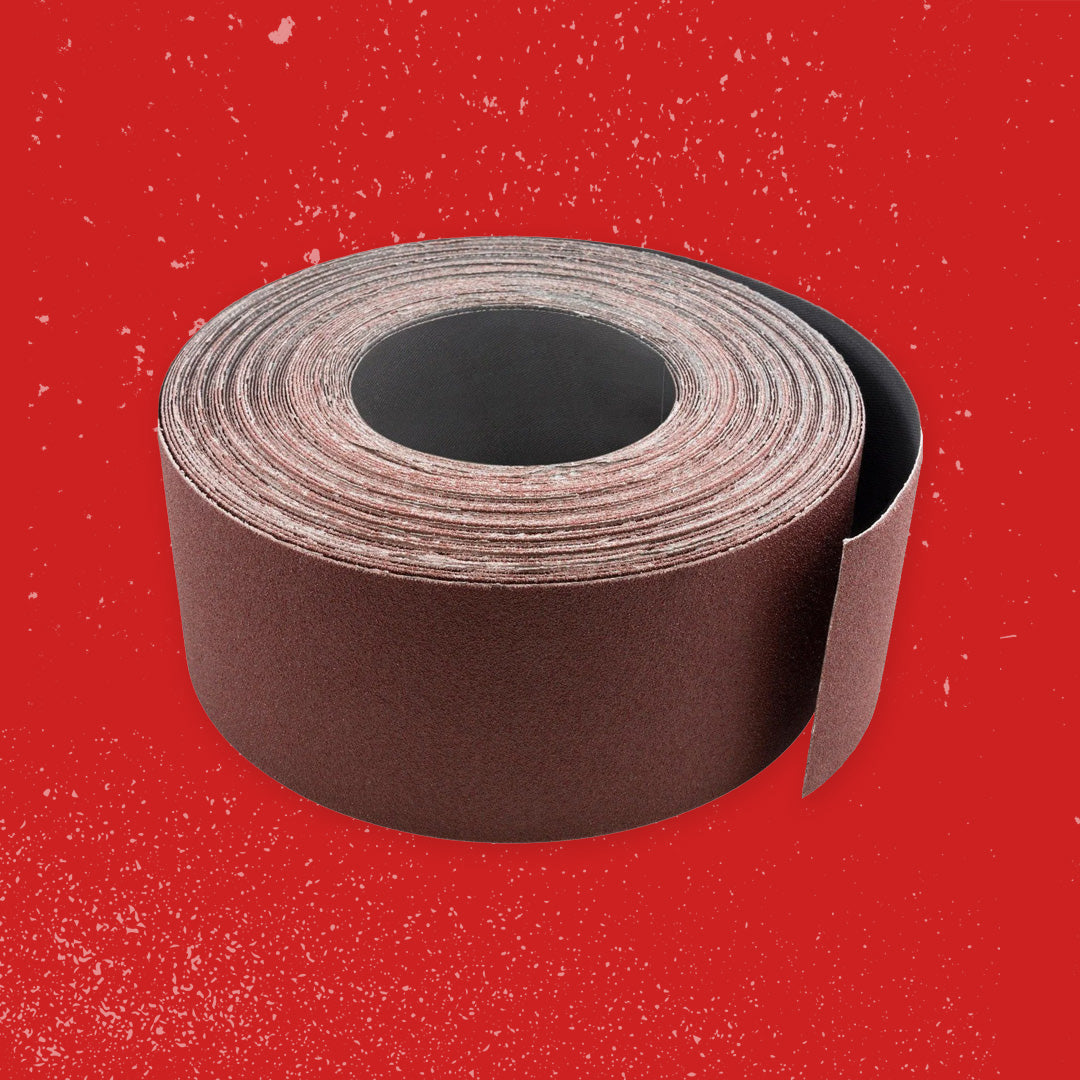
Emery cloth is a rugged abrasive consisting of a woven cloth backing and emery particles, a granular rock containing aluminum oxide and iron oxide (magnetite or hematite). The cloth material, which is usually made from cotton or polyester, is flexible and tear-resistent while the grayish-black emery grit (typically available in sizes from 36 to 220) is secured to its surface by industrial-grade resin or glue.
Emery cloth is ideal for metalworking tasks like rust removal, deburring, polishing, and cleaning corrosion from steel, aluminum, or brass. It resists shredding, conforms to curves, and suits both wet and dry applications, so it’s ideal for plumbing and auto repair. However, when used on a softer material like wood, tiny metallic particles can embed in the grain and react with the natural extractives (tannins) in the wood (especially in the presence of moisture), causing black or gray iron stains.
As an abrasive, emery cloth lasts longer than most sandpaper and can be reused after washing. The cloth backing doesn’t tear even when you're working with sharp edges or applying heavy pressure. It handles wet sanding applications without disintegrating, and the heat resistance prevents the backing from scorching during high-friction work.
Sandpaper consists of heavy-duty paper with abrasive particles adhered to the surface. It’s used to manufacture sanding sheets as well as belts, discs, and rolls. Because sandpaper comes in different sizes and grit types, you can use it in a wide range of tasks, from heavy paint removal to fine finishing. Since a high-quality sandpaper can do an excellent job at smoothing as well as surface preparation, it’s a key tool in workshops where woodworking and metalworking are carried out.
At Red Label Abrasives, we manufacture sandpaper sheets with the following abrasive types:
|
Aspect |
Emery Cloth |
Sandpaper |
|
Abrasive |
Aluminum oxide or emery (crushed emery rock) on woven cloth |
Various grains (silicon carbide, aluminum oxide, zirconia, ceramic) on paper, cloth, or film backing |
|
Backing |
Durable cotton or polyester cloth |
Paper (light duty), cloth (heavy), or mesh/film (water-resistant) |
|
Grit Range |
Typically 36-120 (coarse to medium) |
40-2000+ (ultra-fine available) |
|
Flexibility |
High; conforms to curves |
Varies; paper backings tear easily |
|
Durability |
Tear-resistant, long-lasting |
Wears faster on aggressive tasks |
|
Cost |
Higher per sheet due to cloth |
More affordable, wider availability |
Emery cloth is a fixture in metalworking shops, so if you work in metal fabrication or a related field, you’ll want to stock up. Since the abrasive grain is made from the natural mineral emery (a composite of aluminum oxide and magnetite), it’s hard enough to cut metal yet tough enough to resist fracturing under pressure. The cloth backing resists shredding and tearing during aggressive sanding, making it ideal for:
If you’re using emery cloth for your project, start by selecting the right grit for your task:
Cut or tear a workable piece from your roll (emery cloth tears cleanly along the weave). For flat surfaces, wrap the cloth around a sanding block to maintain even pressure and prevent rounding edges. For curved work, hold the cloth in your hands and conform it to the shape. Apply moderate pressure and work in consistent strokes: too much pressure generates excess heat and clogs the abrasive. After use, you can rinse the emery cloth with water or solvent and reuse it multiple times before the grit wears out.
Pro Tip: For wet sanding, add a few drops of lubricating oil to the surface, which reduces heat buildup and extends the life of the cloth.
As we stated earlier, emery cloth isn't the right choice for wood finishing, as the tiny bits of iron can permanently damage natural wood. The coarser grit range also means you can't achieve ultra-fine finishes that call for 220 grit or higher. It costs more per foot than paper-backed sandpaper, which matters if you're doing light-duty work that doesn't demand the extra durability. For woodworking, drywall, or other non-metal applications, save your emery cloth and reach for sandpaper instead.
Sandpaper is ideal for woodworking, drywall finishing, paint preparation, and any task where you need a wide grit range available. Examples include:
While the grit tells you how fast a product will cut, the backing weight indicates how resilient the product is. Abrasives are generally categorized by a letter system, ranging from "A" (the lightest) to "F" (the heaviest). Choosing the wrong weight can lead to premature tearing or a finish that is too stiff for the job.
You’ll want to use sandpaper with a cloth backing if you’re doing more aggressive sanding or working in a wet environment. Options include:
Pro Tip: If you are sanding a flat surface, a stiffer X-weight or E-weight backing will help keep the surface level. If you are sanding a curved banister or a pipe, a J-weight cloth or A-weight paper will "wrap" around the workpiece much more effectively.
The golden rule of sanding is that you should not skip more than one grit as you progress through the sanding stages. Every scratch you make must be removed by the next finer grit: skip a step and you risk locking in scratches that show up only after staining or coating.
For example, if you start with P80 and need to finish at P240, rather than using every grit from P80 to P220, you can do P80 to P120 to P180, and then P240. Hardwoods generally allow for starting with coarser grits (like 80) compared to softwoods (often starting at 120 or 150). Metals vary too; heavy rust might need 40-60 grit, while smoother metal could start much finer.
You’ll want to wear safety gear that protects you from the dust generated by sanding.
|
Project Type |
Recommended Abrasive |
Starting Grit |
Finishing Grit |
Why This Choice? |
|
Heavy Rust/Scale Removal |
Emery Cloth |
60 Grit |
120 Grit |
Tough backing won't shred on jagged, oxidized metal. |
|
Raw Wood Smoothing |
Sandpaper (Alum. Oxide) |
80 Grit |
220 Grit |
Prevents iron staining; wide grit range for a smooth finish. |
|
Polishing Copper Pipes |
Emery Cloth |
120 Grit |
120 Grit |
Flexible cloth wraps around pipes for 360° cleaning. |
|
Auto Body Paint Prep |
Sandpaper (Silicon Carbide) |
320 Grit |
600+ (Wet) |
Sharp grains and water-resistance provide a mirror-smooth surface. |
|
Knife/Blade Sharpening |
Emery Cloth |
80 Grit |
220+ Grit |
Heat-resistant backing handles the friction of hard steel. |
|
Drywall Seam Leveling |
Sandpaper |
100 Grit |
150 Grit |
Large sheets are cost-effective for high-volume dust removal. |
|
Deburring Metal Edges |
Emery Cloth |
60 Grit |
80 Grit |
Resists snagging and tearing on sharp, freshly cut metal. |
Choosing between emery cloth and sandpaper comes down to what material and application you’re working with. Emery cloth excels at metal grinding, rust removal, and deburring, but isn’t ideal for wood. Sandpaper has the grit range and versatility needed for woodworking, drywall finishing, and automotive paint prep. Any workshop or manufacturing facility that carries both will have everything they need for most applications.
At Red Label Abrasives, we manufacture sanding belts, sanding discs, and sanding sheets in grits suitable for all stages of material shaping, removal, and polishing. Whether you work in a factory-scale facility or need to restock your private workshop, we can help. If you have questions or would like to place an order, please fill out a contact form or call 844-824-1956 today.


EdgeCore Ceramic Sanding Belts

EdgeCore Ceramic Flap Discs
Buffing Kit